
On the question between the Catholic Church and Protestantism, this has become a very old debate now full of many diverse opinions. I find it most important to start with some fundamental truths that the reader should digest. One, it is important for each person to settle the matter of personal worship for themselves, and not merely follow tradition or convenience in which spiritual practice they follow. Above everything, we must set Christ as our sole destination. We do not ultimately debate literature or sacrament, the Church or her saints, but all find ourselves on a personal journey of gaining closer proximity to the resurrected king Jesus Christ.
With this in mind, what are the separations that distinguish the Catholic and Protestant faiths? For both claim to follow Christ, and in so far as both affirm the tenants of the Apostle’s Creed, are both Christian. Afterall, Christianity is fundamentally the religion of all people who hold Jesus alone as their risen Savior and follow the teachings of His ministry. So it follows that we can claim both the Catholic and Protestant as mutually Christian and part of the family of God. Of course there are exceptions in both camps, but largely this is true.
Where then do the distinctions begin? The Catholic Church is old, theoretically dating back to Peter who Catholics believe was the first Pope. Jesus told Peter, “On this rock (Petros) I will build my Church. For Protestants, this statement from Christ is a prophetic indication that Peter and the disciples will begin the early Church. For Catholics, this verse goes deeper. Peter and the disciples were not just the builders of the early church but Peter himself was to become the incarnate mouthpiece of God and leader of the Church. Thus Peter, above others, was anointed by Christ to succeed Himself as the earthly leader of the Church and become an infallible father to God’s children. Importantly, Catholics do not believe this commissioning by Christ left Peter perfect or sinless, but inerrant in his spiritual direction to the Church.
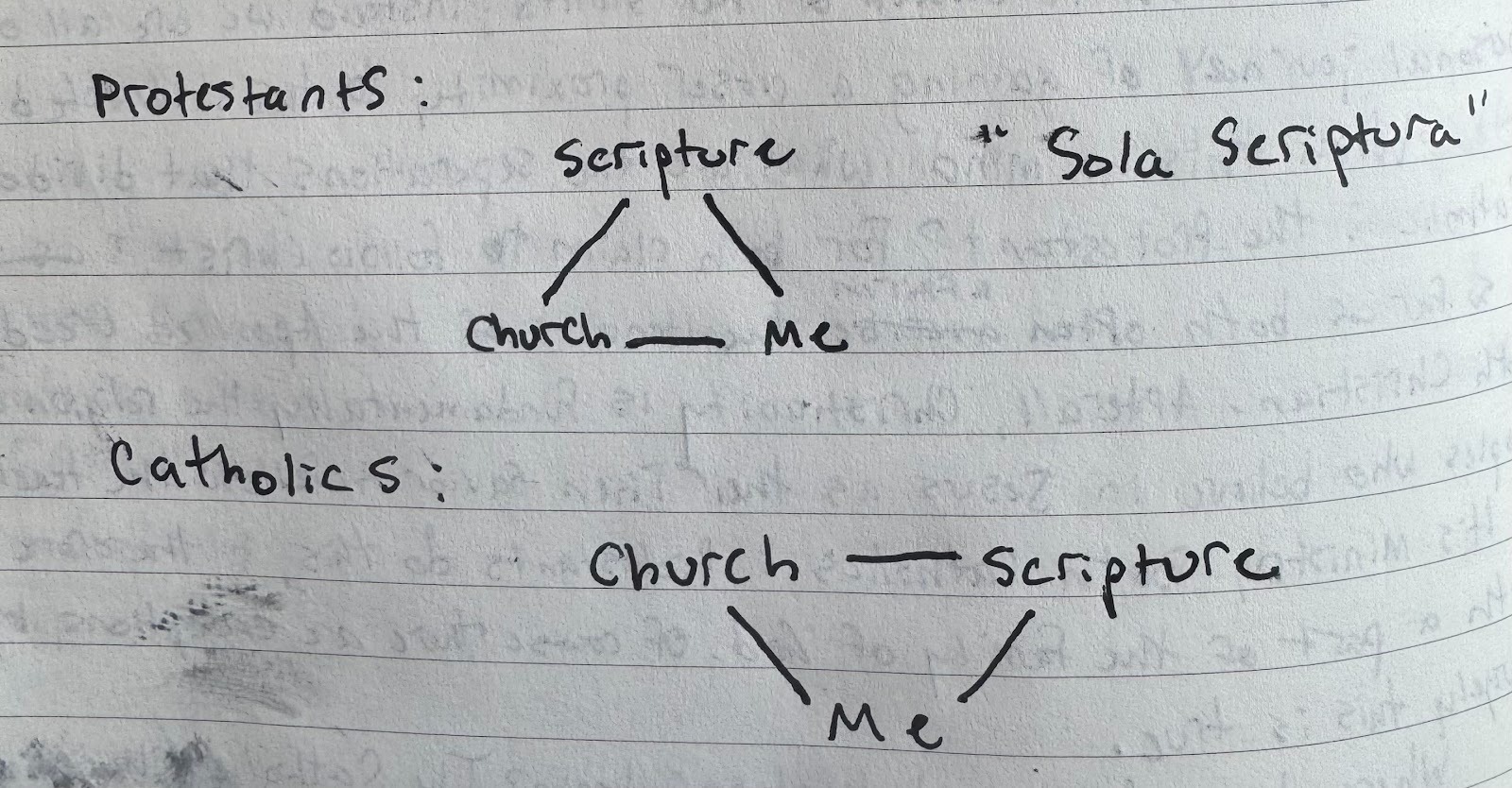
This is perhaps the first fundamental difference between the Catholic and Protestant belief systems. Protestants affirm the importance and spiritual vitality of participating in the Church, but ultimately subscribe to the view that it is Scripture alone which is infallible – Sola Scriptura. If God’s Word is the highest authority, then as St. Augustine said himself,
“Your truth is not mine alone nor does it belong to this man or that. It belongs to us all…If any man claims as his own what you give to all to enjoy and tries to keep for himself what belongs to all, he is driven to take refuge in his own resources instead of in what is common to all.”
Catholics, however, view Scripture and the Church as coequal partners in the spiritual formation of God’s people. Both Scripture and the Pope are infallible, enabling a source of Truth and a mouthpiece of perfect interpretation. This parity of Truth and Doctrine allows for a clear and ordered Church from which God’s people may be nurtured. One central Church led by one infallible Pope lifts a lot of weight and division from the common follower of Jesus. While all Catholics are still called to follow Christ personally as their own savior, the Way is led by a single Church. Local parishes hold tremendous responsibility to shepherd their flocks with direct insight into the ways those members abide and live out God’s Word in accordance with the Vatican.
Protestants on the other hand value transparency and independence over the central order of the Catholic Church. Again, while the Church is important, Protestants do not view it or any of its members as infallible. The driving helper in interpreting Scripture must be the Holy Spirit directly, who lives inside of us. This distinction was born largely from a mishandling of the central Catholic Church during the time of the Reformation. Scripture at that time was read primarily in Latin, which many commoners did not speak. The format of Christian living had shifted away from a triangle and more into a unilateral authority of the Church.

Good Catholic practice means that the parity of Scripture and the Church must be held in tandem with its access to all people. Without access to Scripture, the Church lost its accountability and began to suffer from corruption. Martin Luther, the figurehead of the Protestant Reformation, decided a change in the hierarchy was needed. Scripture alone could not be corrupted, only the readers who attempt to interpret it. Therefore only Scripture should hold the status of infallible, and through the empowered discernment of the Holy Spirit who is made available to all people it can be rightly heard as God’s voice. This then became the first major distinctive of the Catholic and Protestant Church.
A second major distinctive of the two traditions comes into the picture now on the subject of Scripture. It is not just Sola Scriptura that Catholics and Protestants disagree with, but also the agreed upon books which compose Scripture’s canon. Protestants include 66 books in the Bible while Catholics include 73, 7 which separate the two Holy Books. These 7 books are known to Protestants as the Apocrypha, which means “hidden books”, while they are known to Catholics as the Duterocanon or Second Canon. Catholics call it the Deuterocanon not because these books are second in authority to the original 66 books, but because they were accepted after the 66 books of the original canon.
While a difference in canonical Scripture seems significant, and indeed it has been the cause of debate for hundreds of years, I would consider this difference secondary in theological importance. This is because the omitted books in the Protestant Bible are not contrary to the remaining 66 books. In fact, many Protestant and Jewish scholars (these 7 books are also not affirmed as canon in Jewish Scripture) consider the Apocrypha useful and edifying to understanding the context of time leading up to Jesus’ incarnation. Early Church leaders such as Origin and Athanasius pointed to Scripture such as Romans 3:2 as a claim that the issue of what is God-inspired must align with what the Jewish people consider so. Contrastly, other early church fathers such as Augustine and Innocent I argued that so long as a spiritual text qualified as canon and constructive to spiritual formation it should be included.
So the Deuterocanon remained in dispute throughout Church history. While motions to include the books were made, it was not seen as dogmatically binding by many until the time of the reformation. Eventually, core beliefs of the Catholic Church, such as purgatory and prayer to the saints, were derived from these hidden books, and the Church officially ratified these books into its canon. Thus, several issues such as confession, the Saints, prayer for the dead, may never be settled so long as a difference in canon exists between the Protestant and Catholic. Nonetheless, what remains most essential is proximity to Christ. As we engage in the question between Catholicism and Protestantism, may the real destination not be lost. Worship, and in consequence the Church, must always remain a means for lost souls to grow in love from our Almighty God. It is my belief that there will be many Catholics and Protestants standing side by side in the New Earth, exalting our shared King as His saved saints.
To you reader who feels indecisive or overwhelmed by the decision of which spiritual practice is best, I encourage you with this. Jesus said, “to all who confess with their mouth and believe in their heart that God has raised Him from the dead, you will be saved.” God is powerful and sovereign, but He is also gentle and lowly. Jesus is knocking at your door, and this quest for peace you are on is likely the product of His work in your life. Do not journey in fear, do not ask questions timidly. There is no rock in the Catholic or Protestant Church which is greater than God; instead, through the prompting of the Holy Spirit pursue your questions boldly. Listen to His voice, and abide in God’s Word. If you do this, you will find your way and find nearness to your Creator.